Magnificent Humanity Brief
Magnificent Humanity Brief
Magnificent Humanity Brief
The Pope has spoken with rare clarity about AI and the human person. What follows is how one infrastructure — built in strong alignment with the same human-centred principles — responds to that teaching.
On 25 May 2026, Pope Leo XIV published Magnifica Humanitas — On Safeguarding the Human Person in the Time of Artificial Intelligence. It is 245 paragraphs, 42,300 words, and the most extensive magisterial treatment of AI in the history of the Church.
He signed it on 15 May — deliberately, on the 135th anniversary of Rerum Novarum, Leo XIII's landmark response to the Industrial Revolution. The parallel is not subtle. Leo XIV is positioning AI as this generation's industrial revolution — and the Church as having something essential to say about who controls it, who benefits, and who is left behind.
Humanity, created by God in all its grandeur, is today facing a pivotal choice: either to construct a new Tower of Babel or to build the city in which God and humanity dwell together.
Magnifica Humanitas — Opening paragraphThe encyclical addresses governments, corporations, technologists, and — crucially — every person of goodwill. It is not a document about AI in the abstract. It is a framework for deciding whether AI in your ministry, your diocese, your community of the faithful, serves the Gospel or quietly corrodes it.
That question will not wait. It is already being answered, whether ministries act or not.
Not AI hearing confession, offering absolution, or simulating pastoral counsel
Not automated pastoral care replacing human accompaniment and presence
Not social media with a cross on it — platform logic dressed in ministry colours
Not data extraction pretending to serve the faithful while mining their lives
Not a replacement for parish life, the sacraments, or the stewardship of human presence
A governed digital mission field — under pastoral authority — where communication, listening, service, pastoral memory and AI assistance remain in the ministry's hands.
Magnifica Humanitas draws on the full tradition of Catholic Social Teaching — dignity, the common good, subsidiarity, solidarity — and applies each principle directly to AI. Here is what it says.
The encyclical states explicitly: "technology is never neutral, because it takes on the characteristics of those who devise, finance, regulate, and use it." The question is not whether to use AI. It is who governs it, who benefits, and whose values it encodes. A ministry that borrows its digital environment from a commercial platform is borrowing that platform's values — whether it knows it or not.
Leo XIV warns that "the main drivers of development are private, often transnational, parties that are endowed with resources and capacity that surpass those of many governments." The encyclical is direct at §108: "ownership of data cannot be left solely in private hands — data is the product of many contributors and should not be treated as something to be sold off or entrusted to a select few." When a ministry hands its flock to WhatsApp, Facebook, or any surveillance-driven platform, it surrenders its people to exactly the concentrated private power the Pope names as the central danger of this age.
The encyclical applies subsidiarity directly to AI governance: "whatever can be carried out by individuals, families, intermediary organisations and local communities should not be carried out by higher-level authorities." A diocese or parish is not an edge node of a global platform. It is a sovereign community with its own governance, memory, relationships, and pastoral responsibility — and its digital environment should reflect that.
Leo XIV is clear about AI in the workplace: "current approaches to technology can paradoxically de-skill workers, subject them to automated surveillance, and relegate them to rigid and repetitive tasks." For ministry, this is a direct challenge: AI must support the human work of accompaniment, pastoral care, and community coordination — not replace it, simulate it, or reduce ministry to a workflow.
The encyclical's most urgent sentence: "In the era of artificial intelligence, when human dignity is threatened by new forms of dehumanization, ours is the pressing duty to remain profoundly human." The Pope is not asking institutions to avoid AI. He is asking them to ensure that AI is contained within human authority, pastoral responsibility, and ethical governance — that the machine serves the person, and never the other way around.
In the era of artificial intelligence, when human dignity is threatened by new forms of dehumanization, ours is the pressing duty to remain profoundly human.
✦ Direct Papal Text Magnifica Humanitas — On remaining humanCommunity Digital Infrastructure was not designed to respond to an encyclical. But the architecture is in strong alignment with the encyclical's human-centred principles — because it begins with the dignity, agency, and authority of the community.
Technology is never neutral — it takes on the values of those who build and govern it.
Every CDI node is governed by its community. The ministry defines the rules, the boundaries, the permissions, and the values the system encodes. There is no third-party algorithm shaping what people see, who is prioritised, or what is amplified. The values are yours — by design.
Control of data cannot be entrusted solely to private actors. Power must not concentrate in the hands of a few interests detached from local communities.
CDI is explicitly designed to break the platform dependency trap. Each community owns its node, its data, and its governance environment. Your people's conversations, prayer requests, pastoral needs, and community memory do not belong to Facebook, Google, or any advertising-driven network. They belong to the community they came from.
Subsidiarity demands that decisions remain as close to the local community as possible. Authority should serve, not supplant.
CDI's architecture is federated, not centralised. A diocese can run a network of parish nodes, each governed locally, each holding its own community's data and context, each answerable to its own leadership — while sharing a common secure technical layer. Subsidiarity is not just a principle. It is the system design.
AI must not de-skill workers, simulate care, or replace the human responsibility of accompaniment.
AI inside CDI is a briefing tool, not a decision-maker. It surfaces patterns, flags unresolved pastoral needs, and prepares the room — so that clergy and lay leaders can discern, act, and accompany. It does not replace the priest's eye, the deacon's ear, or the pastoral minister's heart. The pastoral responsibility remains, always and fully, human.
Transparency and accountability must govern AI — "data and algorithms must be understandable, contestable and subject to oversight."
CDI maintains audit trails, role-based access, governance logs, and human review pathways at every layer. Nothing in the system is opaque to the community's own leadership. This is not a technical concession. It is the governance architecture the Pope is asking for — built in from the foundation.
A more moral AI is not enough if that morality is determined by a few.
Magnifica Humanitas — §107The alignment with the Pope's teaching is not aspirational — it is structural. CDI's architecture encodes the principles of subsidiarity, data sovereignty, and human authority into the system itself. The community is principal, governor, and boundary. Not the platform.
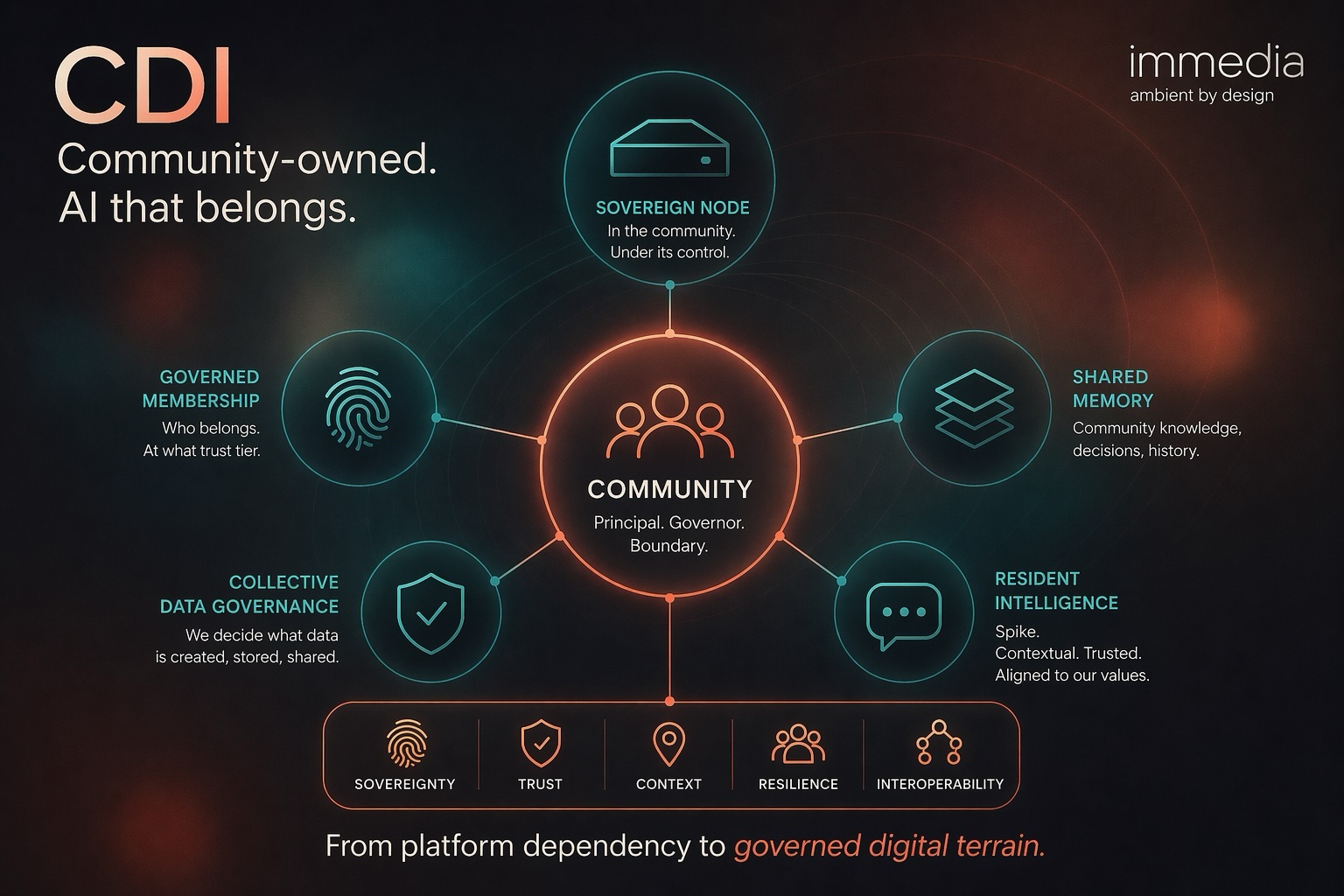
CDI Architecture — Community as principal, governor and boundary
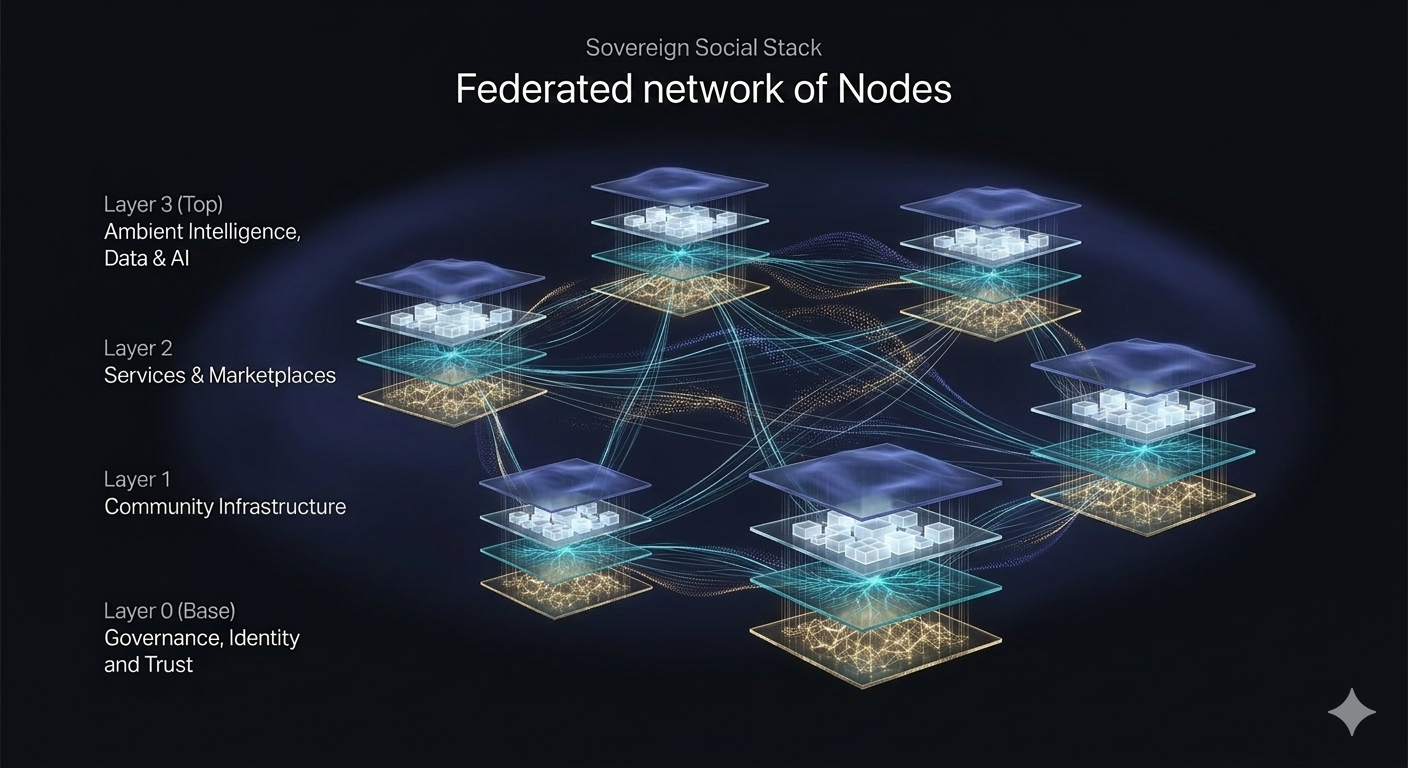
Sovereign Social Stack — A federated network of governed nodes. Each diocese, parish or mission retains its own sovereignty within a shared trusted layer.
Whatever can be carried out by individuals, families, intermediary organisations and local communities should not be carried out by higher-level authorities.
Magnifica Humanitas — on subsidiarity The Community's Own Intelligence
Inside every community node sits what we call a Resident Intelligence — the community's own private capacity to read its own activity and tell its leaders what they need to know. It cannot leave the node. It cannot be accessed from outside. It has no interest in your community's life beyond the mission you have given it.
This is not a connection to some distant service that also handles millions of other communities and their data. The Resident Intelligence knows your sites, your languages, your seasons, your regular volunteers, your recurring gaps — because your community is all it knows.
It does not write reports to impress. It writes them so that the people running the programme can act. The briefing is handed to a coordinator, read in a few minutes, and acted on before the next service window. Then it stays inside the node — unreachable to anyone who has not been given authority to see it.
The Pope's three questions — answered by one design decision
Who has access to it?
Only the leaders your ministry designates. No platform, no vendor, no algorithm running elsewhere in the world.
Who governs it?
The governance charter your leadership defines. It operates within the ethical boundaries the ministry has set — including the things it may never do.
Who does it serve?
The pastoral mission of your community, and no one else. Its findings are not sold, not harvested, not used to train a model sitting somewhere beyond your authority.
This is what disarming AI looks like — not refusing the tool, but changing every condition of its use. The architecture is the ethics.
immedia / Fabrik — design principleWhat it found
That a handful of volunteers across seven sites were carrying more than their share. That the weekend rota held — but was fragile. That Cap-Haïtien and Santiago and Montréal were active, but less visible than Miami. That weekday service was going uncounted.
How it found it
By reading fifty-eight days of check-ins, service records, and rota patterns within a single community's node — using no external data, no comparison to other communities, no training on anybody else's congregation.
Where it went
To the programme's coordinators, in plain language, as a briefing they could act on before the next service window. Then it stayed inside the node — unreachable to anyone without authority to see it.
A CDI deployment does not begin with technology. It begins with a ministry diagnosis: where are your people gathering now, what is being lost, where is pastoral care delayed, and what must never be automated? The node is shaped to your community — not the other way around.
One trusted digital home for the community of the faithful. Not a replacement for the parish notice board — a governed digital commons where people gather, ask, serve, and belong.
Each parish as a governed node within a diocesan network. The bishop's office gains a living view of community participation — without collapsing every parish into a single centralised bureaucracy.
For Caritas-style networks, relief organisations, refugee ministries, and food security programmes. Volunteer coordination and community care without surrendering vulnerable people's data to commercial platforms.
Where audiences become participants, broadcasts become formation journeys, and the Church's reach becomes genuine belonging rather than viewership — governed, purposeful, and answerable to pastoral authority.
Responsible planning, the assessment of human and social impact, the inclusion of the most vulnerable, the promotion of digital literacy — these are the standards of discernment the encyclical asks institutions to translate into concrete action.
Magnifica Humanitas — synthesisThe Resident Intelligence is capable and willing. But capability without limits is precisely what the Pope is warning against. These are the limits — written into the governance of every CDI node before it goes live. Not guidelines on a website somewhere. Rules built into the system your community operates.
Summarise community activity for pastoral leadership — what is being asked, what needs are rising, where care is fragile
Translate approved pastoral content for multilingual communities
Identify recurring pastoral needs and surface them for human attention and discernment
Support volunteer coordination and service logistics without replacing human relationship
Organise FAQs from approved ministry content and direct enquiries appropriately
Surface early risk signals for human review — safeguarding, crisis, vulnerability
Assist accountability reporting and programme transparency
Replace clergy, pastoral counsellors, or the ministry of human accompaniment
Simulate sacramental authority, simulate confession, or offer absolution
Make safeguarding decisions without human review and escalation
Profile community members for manipulation, persuasion, or commercial extraction
Harvest community data for external model training without explicit governance consent
Monetise the spiritual vulnerability or personal circumstances of the faithful
Pretend to be human, simulate personal spiritual relationship, or operate without ministry oversight
The need to keep up with the pace of technology can erode workers' sense of agency and stifle the innovative abilities they are expected to bring to their work. It is necessary to design systems that are centred on the human person and not solely on performance.
Magnifica Humanitas — §156The deployment process is designed to be serious about governance before it is serious about technology. Every phase is a qualification — checking whether the social, pastoral, and operational conditions are real before anything is built for scale.
Map the real communication and coordination life of the ministry. Where are people gathering? What gets lost? Where is pastoral care delayed? Where is leadership blind? What must never be automated? This prevents selling technology into a fog bank.
Before launch: define who owns the node, who moderates, who sees what, what AI may and may not do, how safeguarding is handled, what data is retained, how consent is given, how escalation works. This is the ethical spine of the system.
Start with one bounded community: one parish, one youth ministry, one charity programme. Run it for 60–90 days. Test whether the social, governance, and pastoral conditions are genuine before any thought of scale.
The Resident Intelligence reads the community's own activity and produces a plain-language briefing for whoever the ministry has designated to receive it. Which needs are rising. Who is carrying more than their share. Where the rota is fragile. Where a smaller site is going unnoticed. Not a dashboard. A letter from someone who has been paying attention.
Only after the pilot proves its value does the ministry replicate — parish to parish, mission to mission, programme to programme. CDI scales through governed replication, not by forcing everyone into one monolithic platform.
We will help you test whether your ministry can create a trusted digital mission environment where your people are heard, your volunteers are coordinated, your community memory is preserved, and AI serves pastoral responsibility rather than replacing it.
That is not a technology proposition. It is a stewardship question — and it is exactly the question the Pope is asking every ministry leader to answer.
What you are choosing between
WhatsApp gives speed but not memory.
Facebook gives reach but not governance.
YouTube gives broadcast but not community.
Email gives record but not participation.
AI gives summaries but not moral authority.
CDI gives the ministry a governed digital home.
That is the alignment with the Pope's thinking. And it begins with a single, serious conversation about whether your ministry is ready to govern its own digital mission field.
I ask everyone to abandon the construction of yet another Tower of Babel and to join forces in building up the common good, so that humanity will never lose its beauty.
Magnifica Humanitas — ConclusionWe listen to
The real shape of your ministry's digital life — what is scattered, what is leaking, what is at risk
We design
A governance framework that reflects your values, your authority, and the Pope's explicit ethical requirements
We prove
Value in a bounded 90-day pilot — no speculative rollout, no technology ahead of governance
To begin the conversation
immedia.co.za