Over the course of a single generation the internet has transformed from a fragile academic network into the primary information system of civilisation.
It connects billions of people, distributes knowledge instantly across continents, and allows events anywhere on earth to become visible everywhere else within seconds.
And yet something unexpected has happened.
The network that was meant to connect the world has begun to fracture it.
Information travels faster than understanding. Events propagate globally before they are interpreted locally. Public discourse fragments into competing realities.
This is the paradox of the internet age:
the more connected we become, the less shared context we seem to possess.
The internet changed the speed of information, but it left the structure of trust unresolved.
So trust is reorganising itself. Not primarily around institutions. Not primarily around platforms. Increasingly, it is reorganising around communities.
The next phase of the internet will be built around this geometry.
But I want to be clear about where this argument comes from. Not from a whiteboard in Silicon Valley. From another coast, a world away but no less human — Durban. From four decades of watching the internet arrive unevenly, watching communities in South Africa make meaning without permission from the platforms that were supposed to serve them. The argument isn’t theoretical. It’s been lived.
The Internet Changed the Physics of Society
The internet did not simply connect the world. It altered the conditions under which human societies process information.
For most of history information moved slowly enough for institutions and communities to interpret it before it travelled further. Meaning accumulated locally. Trust formed through repeated interaction. Reputation emerged through time.
The social world had friction.
And that friction allowed interpretation. Digital networks removed much of it.
Information now moves faster than institutions can process it, faster than communities can interpret it, and often faster than individuals can absorb it. Events spread across the world before they are understood anywhere.
We have built extraordinary systems for communication, computation, and distribution.
But we have not yet rebuilt the social infrastructure required to live inside this new informational environment.
The consequences of that gap are increasingly visible: unstable public discourse, declining institutional trust, algorithmic distortion, and the growing sense that reality itself has become contested terrain.
To understand what must come next we must begin with a simple recognition.
Trust has structure. And that structure is changing.
Trust Has Geometry
Trust is often treated as a sentiment, something personal or emotional.
But trust also has architecture.
It emerges through patterns of interaction within networks.
In small groups trust develops through repeated encounters. Individuals observe behaviour over time. Reputation accumulates. Norms emerge. Accountability becomes visible.
Anthropologists often describe this as the social fabric.
Historically, large institutions extended that fabric outward. Newspapers, universities, religious organisations, civic bodies and professional guilds aggregated trust at scale. They mediated between events and public understanding.
The architecture of the modern internet disrupted this geometry.
Digital platforms allow communication to scale instantly across millions of individuals who share little context with one another. At first this expansion appeared liberating. Information became more democratic. Voices multiplied. Participation expanded.
But networks optimised for scale inevitably dilute context.
The larger the network, the thinner the shared interpretive environment becomes.
At small scale, meaning travels through relationships. At massive scale, meaning travels through algorithms.
That is not a minor difference. It is a civilisational one.
The Collapse of Context
The dominant platforms of the internet age operate according to a relatively simple logic: maximise engagement. Content spreads through predictive systems designed to keep attention circulating through the network.
These systems are extraordinarily efficient at distributing information quickly.
But they are largely indifferent to context. Messages travel far beyond the communities that produced them. Nuance evaporates. Interpretation fragments. Events refract through competing narratives.
This phenomenon is often described as context collapse.
Information becomes abundant while shared understanding becomes scarce.
Public discourse begins to resemble a global conversation conducted without a shared room.
Everyone can hear each other. Very few people share the same frame of reference.
The consequences extend far beyond media. Governance becomes reactive. Institutions struggle to maintain legitimacy. Communities struggle to coordinate action.
Most importantly, the conditions required for trust begin to erode.
The Inversion of Trust
When institutional systems lose coherence, trust does not disappear.
It relocates.
Across societies, we can observe a subtle but powerful shift. Instead of flowing primarily through large institutions, trust increasingly migrates towards smaller, more recognisable networks: professional circles, neighbourhood groups, cultural communities, faith networks, shared-interest associations.
We saw this in South Africa with particular clarity. During the COVID lockdowns, the July 2021 unrest in KwaZulu-Natal, the floods — in each instance it was not the state or the platform that held first. It was the community WhatsApp group. The street committee. The faith network. The neighbourhood radio. These structures have always existed. Digital gave them bandwidth.
Trust didn’t collapse. It inverted. It stopped flowing down from authority and started moving sideways, through proximity.
These environments restore context.
Participants share identity markers, common concerns, and some degree of mutual accountability. They recognise each other. They observe behaviour over time. They develop norms that are legible from within.
In effect, they recreate the conditions under which trust can form.
This is the inversion of trust.
Twentieth-century societies relied heavily on vertical institutions.
Twenty-first-century societies increasingly organise themselves through horizontal networks.
Yet the digital infrastructure of the internet has not adapted to this shift.
The dominant systems of digital life remain optimised for mass attention markets rather than structured communities.
That is the fault line.
The Missing Layer of the Internet
Digital infrastructure has evolved rapidly in many directions.
Identity systems authenticate people online. Payment systems enable global commerce. Cloud platforms store and process immense quantities of data.
Together these capabilities form the backbone of what policymakers increasingly describe as Digital Public Infrastructure.
Yet one crucial layer remains largely undeveloped.
The internet still lacks a native architecture for communities themselves.
Communities certainly exist online, but most inhabit systems designed for other purposes. Social platforms optimise for engagement and advertising. Messaging systems optimise for immediacy. Enterprise software optimises for productivity and control.
None were designed to support communities as long-lived social organisms.
As a result, much of the world’s real social coordination now takes place inside improvised digital spaces. These spaces can be useful. But they struggle to accumulate shared memory. They struggle to govern themselves. They struggle to generate meaningful insight into the communities that inhabit them.
There are now dozens of platforms attempting to fill this gap — Discord, Geneva, Mighty Networks, even the Fediverse. Each makes a version of this argument. What distinguishes a real community layer from another engagement platform is not the feature set. It is the underlying logic: does the platform extract value from the community, or does it return value to it? Does the community own its data, its memory, its norms — or does it merely rent space on someone else’s infrastructure?
That distinction is everything.
And yet they produce something extraordinarily valuable.
They produce human signal.
The Intimacy Economy
As the limitations of attention-driven platforms become clearer, a different economic pattern is beginning to emerge.
Value increasingly forms around trusted networks rather than anonymous audiences.
Neighbourhood groups coordinate local services. Professional communities share expertise. Creators cultivate subscription communities grounded in identity and belonging. Organisations focus less on raw reach and more on deeply engaged participation.
This emerging pattern can be described as the intimacy economy.
In the intimacy economy, value derives not from scale alone, but from the density of relationships and the accuracy of context.
Trust reduces transaction costs. Shared context accelerates decision-making. Reputation shapes behaviour. A smaller community with strong internal trust can often coordinate more effectively than a vast audience connected only by algorithms.
We have seen this play out at the node level. A single residential estate community on a Fabrik-powered network generates more localised economic activity — local services coordinated, offers contextually made, problems solved before they escalate — than the same group of people scattered across a general social platform. The density of the trust field is the difference. Not the technology. The trust.
As trust becomes scarce at scale, its value within communities rises. Trust becomes a form of social capital — and social capital, properly infrastructured, becomes an economic one.
Trust Fields
Communities do more than organise people. They generate fields of trust.
Every community produces patterns of behaviour, conversation, sentiment, and shared experience. These patterns form an environment within which information travels and cooperation emerges.
In strong trust fields:
- information spreads more reliably,
- reputation influences behaviour,
- cooperation becomes easier,
- social norms stabilise interaction.
Weak trust fields produce opposite dynamics.
- Misinformation spreads easily.
- Cooperation collapses.
- Conversations become adversarial.
- Communities fragment.
Large social media environments tend to dilute trust fields because they mix many unrelated communities within the same informational space. When communities regain their own environments, trust fields become stronger and more coherent.
This is not merely a social observation. It is an economic one. The trust field is the infrastructure. Everything else — services, markets, media, civic coordination — runs on top of it.
Understanding and designing for these fields may become one of the central tasks of the digital age.
Context Windows and the Editing of Reality
Human beings interpret the world through context windows.
A context window is the range of information within which events make sense.
For most of history, these windows were relatively stable. Communities shared similar information environments, usually mediated by local institutions. Digital networks expanded those windows dramatically. Individuals now encounter political, cultural, scientific and economic developments from across the world within the same stream of information.
The result is an environment in which reality itself feels increasingly fluid.
Interpretations shift rapidly. Narratives collide. Collective understanding becomes unstable. Public life takes on the strange quality of something continuously rewritten in real time.
In such an environment communities play an essential role.
They stabilise interpretation. They provide shared frames through which events can be understood. They do not eliminate disagreement, nor should they. But they create environments within which disagreement can occur inside a coherent context.
In a world where reality feels endlessly editable, communities act as anchors of meaning.
Sovereign Social
These developments suggest a different architecture for the internet.
Instead of communities existing inside platforms, platforms may increasingly exist in service of communities.
This is the logic of Sovereign Social.
In Sovereign Social environments, communities operate as self-governing digital spaces rather than passive audiences inside global systems. Identity is anchored in relationships rather than anonymous accounts. Data remains contextual rather than extractive. Participation unfolds chronologically and socially, not merely through opaque algorithmic manipulation.
This does not mean large platforms disappear. It means the digital ecosystem is rebalanced towards human-scale environments capable of sustaining trust.
But a note of precision here. The philosopher Onora O’Neill spent her career distinguishing between trust and trustworthiness — and the distinction matters enormously for what we are trying to build. Trust is what people feel. Trustworthiness is what systems deserve.
The failure of Big Social is not simply that people stopped trusting platforms. It is that the platforms were not trustworthy — they were optimised for engagement rather than reliability, for reach rather than honesty, for retention rather than the genuine interests of the communities they claimed to serve.
Sovereign Social, therefore, is not an attempt to manufacture trust. It is an attempt to build systems that deserve it. The governance structures, the community ownership of data, the accountability to members rather than shareholders — these are not features. They are the conditions of trustworthiness.
Trust, if it comes, follows from that. It cannot be engineered directly. It can only be earned.
Nor should community be romanticised. Communities can be exclusive, captured, insular, political. The Incel group is a community. The WhatsApp chain spreading vaccine misinformation is a community. What distinguishes Sovereign Social from those formations is not the fact of community but the presence of governance — real accountability, real members, real consequences for behaviour, and a digital substrate that serves rather than inflames those dynamics.
We are not talking about communities as an ideal. We are talking about communities as a governed, real-world entity, augmented by digital infrastructure, accountable to their members. That accountability is what platforms cannot provide — and what communities, at their best, already possess.
Community Digital Infrastructure
If Sovereign Social describes the philosophy of this shift, Community Digital Infrastructure — CDI — describes the practical layer required to support it.
CDI is digital infrastructure designed for communities as coherent social systems. It provides environments for trusted communication, governance, shared memory, participation, services, marketplaces and insight.
Rather than treating individuals as isolated users within global platforms, CDI treats communities themselves as the organising units of digital life.
This matters because communities do not simply communicate. They coordinate. They remember. They govern. They transact. They develop norms. They create both social and economic value.
A digital architecture that serves communities must therefore do more than host content. It must support the life of the group.
That opens the door to new forms of civic and commercial activity. Communities can coordinate local economies, manage civic participation, preserve institutional memory, and generate meaningful insight into their own dynamics — without surrendering the whole social layer to extractive platforms.
CDI is not designed for spontaneous, user-generated platform communities. It is designed for communities with prior social legitimacy, governance structures, and enduring institutional purpose.
Many governed communities do not exist as isolated units, but as nested or federated networks, and CDI is designed to augment both the individual community and the wider trust network to which it belongs.
The Human Signal Layer
These dynamics become even more significant in an era increasingly shaped by artificial intelligence.
Modern AI systems depend on vast quantities of data. Yet much of the internet’s data environment is becoming increasingly synthetic. Generative systems produce automated content. Algorithmic amplification distorts behaviour. Information drifts further from lived experience.
What becomes scarce in this environment is authentic human signal. Communities generate precisely this signal.
Jaron Lanier has argued for years that AI should be understood not as a technological achievement but as a social collaboration — that every model is built from the creative and intellectual work of the humans whose data trained it, and that those humans deserve equity in the systems built on their signal.
He calls this data dignity. It is a powerful argument. But it is framed around the individual. What community infrastructure adds to Lanier’s insight is a shift in the unit of analysis: not the individual’s data, but the community’s collective signal.
The conversations, norms, local knowledge, shared memory, and emotional texture of a real community are not the sum of individual data points. They are something that only exists relationally — generated between people, not by them in isolation.
This means that community-generated signal cannot simply be purchased or scraped or licensed at the individual level. It requires the community’s consent, governance, and participation.
The community is not a data source. It is the author.
Within trusted environments, people produce knowledge grounded in lived experience: local knowledge, emotional sentiment, collective interpretation, practical memory, social response. This data is relational, contextual and meaningful. It carries the texture of reality rather than the residue of optimisation.
In an AI-shaped world, such signal may become one of the most valuable resources on the internet.
But here is the harder question: who should govern that signal? If community-generated human data becomes extraordinarily valuable, the extractive logic that destroyed the first internet will attempt to colonise this one too. The architecture of CDI must therefore answer a question that platforms never had to ask: how does the community that generates the value, capture the value?
That is not a technical question. It is a governance one. And it is the question that will determine whether the intimacy economy liberates communities or simply becomes the next frontier of extraction.
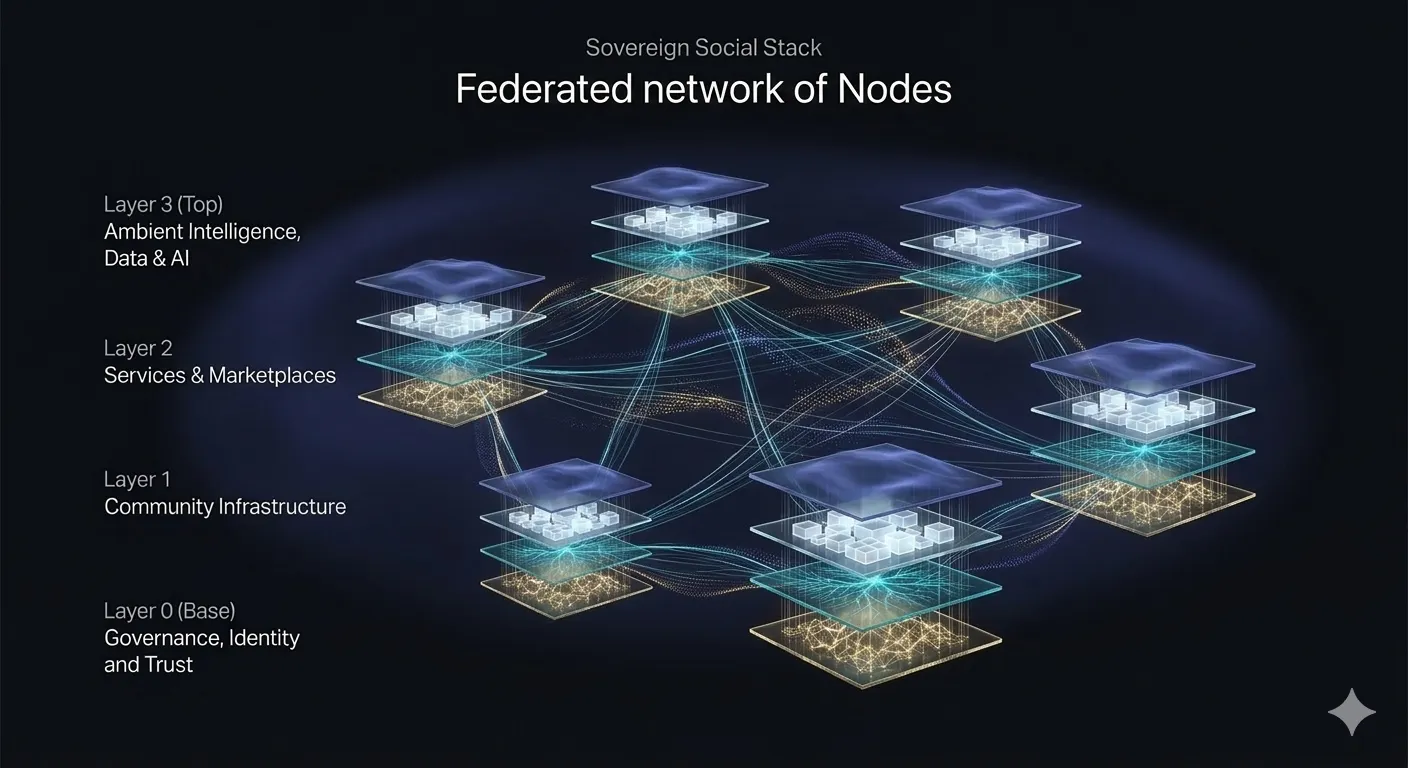
A Network of Communities
The next phase of the internet may therefore look very different from the platform era that preceded it.
Instead of a small number of global platforms mediating most digital interaction, we may see the emergence of thousands of interconnected community networks.
Neighbourhood networks. Cultural networks. Professional networks. Educational networks. Civic networks.
Each community operates its own sovereign digital environment while connecting to others through shared infrastructure and standards.
The result is not a network of attention markets, but a network of trust environments.
Many communities do not stand alone. They already operate as part of wider federated networks: churches with branches and dioceses, sports clubs within leagues and associations, business bodies with chapters and umbrella structures, estates within management groups, schools within districts, stations within media systems.
In such cases, CDI is not creating a network where none existed. It is giving digital form to trust relationships, authority structures, content flows, and service coordination that are already present in the real world.
Rebuilding the Social Operating System
The internet began as a technological network connecting computers. It evolved into a social network connecting individuals.
Its next phase may involve something deeper: a neo-social network of communities capable of organising themselves digitally.
This transformation will not occur overnight. It requires new infrastructure, new governance models, and new economic frameworks. But the forces driving it are already visible — in the WhatsApp groups that coordinated flood relief faster than any government agency, in the community radio stations that outlasted cable news during load-shedding, in the residential networks that are already generating local economic ecosystems outside the feed.
Watch what is happening right now. A woman named Reneé Good is shot in her car by ICE agents in America, and for the first time in living memory, alternative facts don’t metastasise. They are tested in real time, compared against a lattice of shared evidence — the dog on the back seat, the soft toys on the dash, the words I’m not angry with you spoken seconds before gunfire — and they collapse. Not because an institution corrected the record. Because the community context window was wide enough, and resolved fast enough, that falsehood could not achieve coherence. The same week, an American president lays claim to Venezuelan sovereign oil wealth in procedural language designed to keep context thin. One event allows it. The other does not. The difference is not the power of the state. It is the density of the shared context surrounding it. This is the inversion made visible — trust migrating not from one institution to another, but from institutional insulation to community transparency. It is happening at speed. It is not reversing.
These are not case studies in a PowerPoint. They are evidence. The architecture is already forming in the places that had no choice but to build it themselves.
Trust is reorganising itself around communities.
Digital systems will eventually have to follow.
Community Digital Infrastructure is one attempt to build for that future by aligning digital architecture with the enduring geometry of human trust.
Let me be specific about what that means architecturally.
A community layer provides four primitives that no existing internet layer supports natively:
- governed membership (who belongs, decided by the community itself);
- shared memory (a persistent, community-owned record of collective experience);
- contextual identity (identity that is relational and role-based rather than anonymous or universal); and
- collective data governance (the community decides what is shared, with whom, and on what terms).
These are not features to be added to existing platforms. They are the architectural foundation that existing platforms were never designed to provide.
The next internet may not belong to platforms.
It may belong to communities.
And the infrastructure that enables those communities may become one of the most important architectures of the coming century.